The Crust Mushroom Farm vs Hydroponic Farm — Which Feeds Your Colony Better
Published 2026-09-205 min read
The Crust mushroom farm vs hydroponic farm compared: slag-to-organics rates, power, water, CPU and staffing so you know which food farm to build first.
Both food farms eat the same input and grow the same output — the difference is what they demand around them. The community wiki documents both machines (data verified at version 0.99.55; exact costs may have shifted in 1.0 patches), and side by side they look like this:
The numbers
| Mushroom Farm | Hydroponic Farm | |
|---|---|---|
| Required research | Mushroom Farm | Food Cultivation Technologies |
| Recipe | 5 slag → 10 organics per 180s (≈3.3 organics/min) | 5 slag → 20 organics per 400s (≈3.0 organics/min) |
| CPU | 1 | 2 |
| Power | 6 | 8 |
| Water | 3 | 6 |
| Staffing | Biologist ×4 | Biologist ×2 |
| Output storage | 60 organics, refrigerated | — (stub on the wiki) |
| Notes | Output should feed a Cold Storage Cabinet or a Carbon Fiber Factory | Social research adds Organic growth +20% |
(One wiki oddity worth flagging: the infobox purchase prices — 97,800 for the mushroom farm vs 10,170 for hydroponics — predate 1.0 and look stale; check the in-game market rather than trusting either number.)
What that means in practice
- Throughput is nearly a wash — ~3.3 vs ~3.0 organics per minute. Neither farm is a production jackpot; you build several either way.
- The mushroom farm is the efficiency pick per unit: half the CPU, half the power, half the water, and it doubles as the organic supplier a Carbon Fiber Factory wants — carbon fiber being one of the hungriest endgame materials (the final documented mission asks for ~4,955 of it).
- The hydroponic farm is the staffing pick: two biologists instead of four. If your colonist roster is small, four staffed mushroom farms means a dedicated biologist shift you may not be able to afford.
- Both farms eat slag. That's by design — fungus and hydroponics grow in waste products — but it means food and slag-concrete production compete for the same byproduct stream. Watch your slag balance when you scale either.
- Mushroom output is fussy: the farm holds 60 refrigerated organics and wants a cold-storage or carbon-fiber connection; dumping it into general storage wastes the refrigeration and risks spoilage-driven stalls.
How many farms do you need?
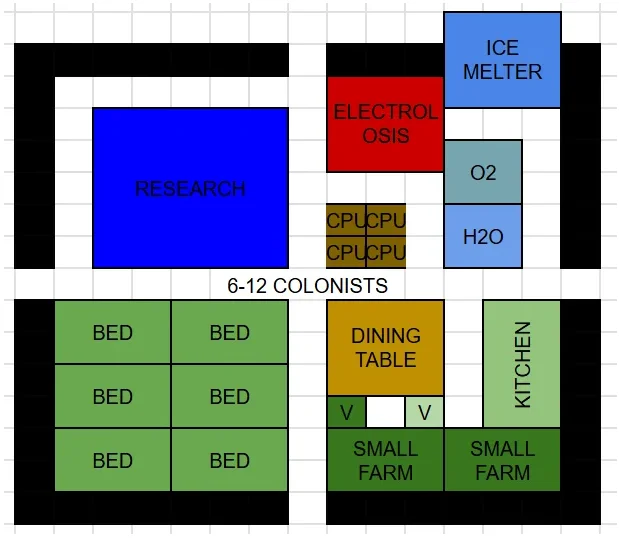
Working bases keep food production inside the habitat envelope: a popular community blueprint for a 6–12 colonist module packs the dining table, kitchen and two small farms in a single quad. In documented 1.0 runs, players typically place hydroponic farms in pairs ("maybe even two") once the kitchen exists — and remember colonists won't eat properly without a table to sit at; food without dining furniture tanks comfort even when bellies are full.
For where farms fit the wider base plan — living quarters middle-and-right, factories top-left — see the layouts guide; for the colonist side (needs, traits, hiring), the colonists guide covers the people math; for what the organics become on plates, see recipes.